The user wants a complete, publish-ready MDX article body about Bates numbering for discovery production. Let me carefully plan this out.
Key requirements:
- Length: 1400-2000 words
- Start with 2-3 sentence hook paragraph (no heading) using primary keyword
- Use ## for sections, ### for sub-points, never # (H1)
- Primary keyword in first paragraph, at least one H2, and naturally throughout
- At least one Markdown table
- Current year references use 2026
- FAQ section with ### headings for each question
- Plain Markdown only, no HTML/JSX components
- Never write bare "<" followed by digit/space in prose
- Output only Markdown body, no frontmatter, no code fence
Primary keyword: "how to Bates number PDFs for discovery production" Secondary keywords: Bates stamping PDF documents, Bates numbering format examples, discovery production numbering, Bates number prefix conventions, legal document Bates stamping
Sections (H2):
What Bates Numbering Means in Discovery Production
Choosing Your Bates Number Format
Prefix and Suffix Conventions Explained
Tools for Bates Numbering PDFs
Step-by-Step: Bates Numbering in Adobe Acrobat Pro
Numbering Multiple PDFs in One Production Set
Redaction, Confidentiality Stamps, and Bates Order
Quality Control Checklist Before You Produce
Frequently asked questions
Internal links:
Let me write this out carefully, making sure it's substantive, accurate, and useful for paralegals and litigation support staff.
Let me draft the content:
Hook paragraph: Need to use primary keyword "how to Bates number PDFs for discovery production" naturally.
Let me write this out fully and count words as I go.
I need to be careful about:
- Not using "<" followed by digit or space in prose
- Using 2026 for current year references
- Including the internal links naturally
- Including a table
- Making it 1400-2000 words
- FAQ with ### headings
Let me draft:
Learning how to Bates number PDFs for discovery production means mastering one of the most repetitive — and most consequential — tasks in litigation support. Every page you produce needs a unique, sequential identifier that holds up under deposition, motion practice, and trial. This walkthrough covers format selection, prefix conventions, redaction order, and the quality-control steps that keep your production defensible.
What Bates Numbering Means in Discovery Production
Bates numbering is the sequential page-identifier system applied to documents produced in litigation. Each page receives a unique number — typically a prefix plus a zero-padded sequence — so that any page can be cited precisely during deposition, motion practice, or trial. When a witness is asked about "DEF-000347," everyone in the room is looking at the same page.
The term comes from the Bates Manufacturing Company, which patented an automatic hand-stamping device in the late 19th century. The mechanical stamp is now a relic, but the concept is unchanged: every produced page gets a unique, sequential mark. In modern practice, that mark is applied electronically to PDFs before production.
Discovery production numbering serves three functions at once:
- Identification — each page has one and only one Bates number, so citations are unambiguous.
- Tracking — you can trace any produced page back to its source document and custodian through a load file or production log.
- Authenticity — the Bates stamp becomes part of the produced image, making it difficult to swap or substitute pages after production.
Most jurisdictions do not codify a specific Bates format, but protective orders and case management orders frequently do. Before you stamp a single page, pull the governing order and any agreed-upon protocol. If the parties have stipulated to a format, that controls — not your firm's default preference.
Choosing Your Bates Number Format
A Bates number has two core parts: an optional prefix (and sometimes a suffix) and a sequential number. The sequential number is almost always zero-padded so that pages sort correctly and gaps are obvious.
Digit Length
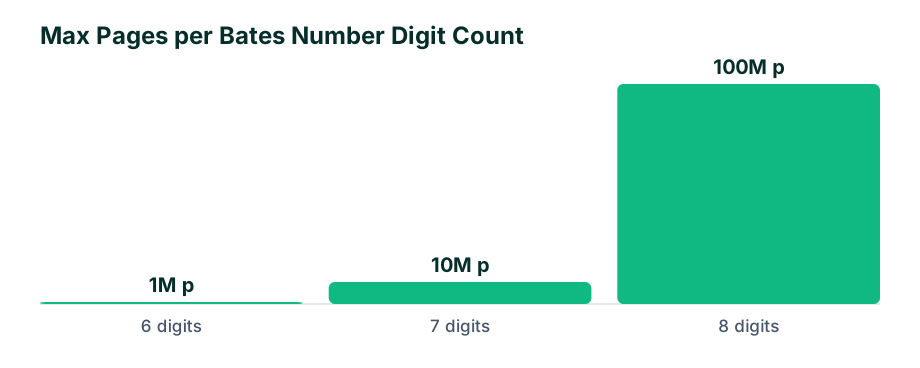
Most firms use 6 to 8 digits for the numeric portion. Six digits (000001–999999) cover one million pages, which is enough for most single-matter productions. Eight digits cover 100 million pages and are common in large multidistrict litigation or government investigations. The key is choosing a length before you start and never changing it mid-production.
| Production size | Recommended digits | Example Bates range |
|---|---|---|
| Under 10,000 pages | 6 | PARTY-000001 to PARTY-010000 |
| 10,000–100,000 pages | 6 | PARTY-000001 to PARTY-100000 |
| 100,000–1,000,000 pages | 7 | PARTY-0000001 to PARTY-1000000 |
| Over 1,000,000 pages | 8 | PARTY-00000001 to PARTY-10000000 |
Zero Padding
Always zero-pad. "PARTY-1" and "PARTY-10" sort incorrectly in most systems; "PARTY-000001" and "PARTY-000010" sort correctly. Padding also makes gaps immediately visible during QC.
Separators
Common separators between prefix and number include a hyphen (DEF-000001), an underscore (DEF_000001), or no separator at all (DEF000001). Hyphens are the most widely used and the most readable. Whatever you choose, apply it consistently across the entire production set.
Prefix and Suffix Conventions Explained
Bates number prefix conventions vary by firm and by case, but the most common approach uses party initials or a matter code.
Common Prefix Patterns
- Party initials — DEF for defendant, PLTF for plaintiff, or a party abbreviation like ABCCO for a company. Example: DEF-000001.
- Custodian code — SMITH-000001, where SMITH is the custodian. Useful when you need to trace pages back to a specific source.
- Matter code — A short alphanumeric code tied to the matter, often combined with a party identifier. Example: 26-CIR-DEF-000001.
- Date-based — Less common, but some firms embed a date or production date. Example: 20260620-000001.
Suffixes
Suffixes appear after the sequential number and are used less frequently than prefixes. Typical uses:
- Confidentiality markers — DEF-000001-CONF or DEF-000001-HC (highly confidential).
- Document segment indicators — DEF-000001-A, DEF-000001-B for attachments or sub-documents within a single Bates range.
- Version indicators — DEF-000001-V2 for a revised or re-produced page.
Check the Order First
Always check the discovery order, protective order, or stipulated protocol before choosing a prefix. Some judges require specific conventions, and some opposing counsel will insist on particular formats during the meet-and-confer. Renumbering after production is costly and can create inconsistencies that opposing counsel will exploit.
Tools for Bates Numbering PDFs
You have several categories of tools for Bates stamping PDF documents. The right choice depends on volume, budget, and whether you are working inside a review platform.
| Tool category | Examples | Best for | Typical cost |
|---|---|---|---|
| PDF editors | Adobe Acrobat Pro, Foxit PDF Editor | Small to mid-size productions, manual workflows | License-based |
| eDiscovery platforms | Relativity, Everlaw, Reveal, DISCO | Large productions, platform-integrated workflows | Per-GB or per-user |
| Dedicated stamping utilities | BatesStamp and similar | High-volume stamping without a full review platform | Varies |
| Scripting / automation | Python with PyPDF2 or pdf libraries | Custom workflows, bulk processing | Development time |
For most litigation support teams, Adobe Acrobat Pro remains the default for manual or small-batch stamping, while eDiscovery platforms handle numbering as part of the production export. If you are producing from a review platform like Relativity or Everlaw, the platform applies Bates numbers during the production job — you typically do not stamp separately in Acrobat.
Step-by-Step: Bates Numbering in Adobe Acrobat Pro
This section covers the Acrobat Pro workflow, which is the most common manual method. The exact menu names vary slightly between Acrobat versions, but the core steps are stable through the 2026 release.
1. Prepare Your PDFs
Before stamping, confirm every document is a single PDF (or combine files first). Ensure pages are oriented correctly, OCR has been run if you need searchable text, and any redactions are already applied. We cover redaction order in detail below — but the short version is: redact first, stamp second.
2. Open the Bates Numbering Tool
In Acrobat Pro, go to Tools and select Bates Numbering (in some versions, it is under Edit PDF then More then Bates Numbering). Choose Add.
3. Add Files
Select the PDFs you want to stamp. You can add multiple files and arrange them in the order they should be numbered. Acrobat will number them sequentially across all files in the list.
4. Configure the Number Format
In the Bates Numbering dialog:
- Prefix — enter your agreed-upon prefix (e.g., DEF).
- Number of Digits — set to 6, 7, or 8 depending on production size.
- Start Number — typically 1, unless you are continuing from a prior production batch.
- Suffix — add if your protocol requires it (e.g., CONF).
- Separator — choose a hyphen, underscore, or none.
5. Set Appearance and Placement
Choose font, font size, and color. Most firms use a small, legible font — 8 to 10 point — in black or dark gray. Standard placement is the bottom-right corner of each page, but some protocols specify the top-right or a different location. Check your order.
6. Apply and Review
Click OK to apply the stamps. Acrobat processes the files and applies the Bates numbers sequentially. Open the first and last pages of each file to confirm the numbers are correct, legible, and properly placed.
Numbering Multiple PDFs in One Production Set
When you are producing dozens or hundreds of separate PDFs, the challenge is maintaining a continuous sequence across files. Acrobat handles this when you add multiple files in one Bates numbering job — it numbers them in the order listed and continues the sequence across file boundaries.
File Order Matters
The order in which files appear in the Bates numbering dialog determines the sequence. Before you stamp, arrange files in the order your case team wants them produced. If you are working from a review platform export, the platform typically handles this through the production load file.
Batch Productions
For large productions, work in batches. Record the last Bates number used in each batch so the next batch starts at the correct number. A simple tracking log prevents gaps and overlaps:
| Batch | Files | Start Bates | End Bates | Date stamped |
|---|---|---|---|---|
| 1 | Emails 1–500 | DEF-000001 | DEF-001250 | 2026-06-15 |
| 2 | Contracts | DEF-001251 | DEF-001890 | 2026-06-16 |
| 3 | Financial records | DEF-001891 | DEF-003420 | 2026-06-18 |
Avoiding Overlaps
If multiple people are stamping different batches in parallel, assign non-overlapping ranges upfront. Person A stamps 000001–001000, Person B stamps 001001–002000, and so on. This prevents two people from stamping the same range.
For more on managing multi-file productions, see our eDiscovery and discovery resources.
Redaction, Confidentiality Stamps, and Bates Order
The order in which you apply redactions, confidentiality stamps, and Bates numbers matters. Get it wrong and you may have to re-stamp, re-produce, or explain to opposing counsel why your Bates numbers are inconsistent.
The Correct Order
- Redact first. Apply all redactions and burn them into the PDF so the redacted content is truly removed, not just covered.
- Apply confidentiality stamps. Add any required confidentiality designations (CONFIDENTIAL, ATTORNEYS' EYES ONLY, HIGHLY CONFIDENTIAL) as a separate stamping step.
- Bates number last. Apply Bates numbers after redactions and confidentiality stamps so nothing obscures or shifts the Bates identifier.
Why Redaction Before Bates
If you Bates number first and then redact, two problems can occur. First, a redaction box can cover the Bates number, forcing you to re-stamp. Second, some redaction tools re-render the page, which can shift or drop the Bates stamp entirely. Redacting first eliminates both risks.
Confidentiality Stamps and Bates Coexistence
Confidentiality stamps and Bates numbers should occupy different areas of the page. Standard practice puts confidentiality designations at the top of the page and Bates numbers at the bottom-right. If your protocol requires both at the bottom, stagger them — confidentiality at bottom-left, Bates at bottom-right — so they do not overlap.
Redaction Verification
After redacting and before Bates stamping, verify that redactions are burned in. Open the PDF, try to select text under the redaction box, and confirm nothing is accessible. In Acrobat, use the Search & Redact tool and then Apply to finalize. Only after redactions are confirmed should you proceed to Bates numbering.
Quality Control Checklist Before You Produce
QC is not optional. A production with Bates errors — gaps, duplicates, obscured numbers, or wrong prefixes — creates problems that are expensive to fix and embarrassing to explain.
Pre-Production QC Checklist
- Bates prefix matches the discovery order or agreed protocol
- Digit length is consistent across the entire production set
- No gaps in the sequence (every number from start to end is present)
- No duplicate Bates numbers
- Bates numbers are legible at production resolution (300 DPI is common)
- Placement is consistent on every page (same corner, same offset)
- Redactions are burned in and verified — no text is selectable under redaction boxes
- Confidentiality stamps do not overlap Bates numbers
- First and last pages of each file have correct numbers
- Load file or production log matches the stamped PDFs
- File names align with Bates ranges (if your protocol requires it)
- Sample pages reviewed by a second person — not just the person who stamped them
Common Pitfalls
- Stamping before redacting — the single most common error. Redact first, always.
- Inconsistent digit padding — mixing 5-digit and 6-digit numbers within one production. Pick a length and stick with it.
- Wrong file order in Acrobat — files numbered out of intended order because the list was not arranged before stamping.
- Obscured Bates numbers — stamps placed over existing text, headers, or footers that make the number hard to read.
- Forgetting to OCR — if your production needs to be text-searchable and you stamp without OCR, the final PDF may not be searchable.
- No second set of eyes — the person who stamped should not be the only person who QC'd. Fresh eyes catch gaps and overlaps.
Post-Stamping Verification
After stamping, run a quick verification pass:
- Open the first PDF and confirm the first Bates number is correct.
- Open the last PDF and confirm the last Bates number is correct.
- Spot-check 5 to 10 files in the middle of the range.
- Confirm the total page count matches the expected Bates range (End Bates minus Start Bates plus one should equal total pages, assuming no gaps).
- Cross-reference against your tracking log.
For more on production workflows and common pitfalls, browse our Bates numbering guides.
Frequently asked questions
What is Bates numbering in legal discovery?
Bates numbering is the sequential identification system applied to each page of documents produced in litigation, ensuring every page has a unique reference for tracking and citation.
How many digits should a Bates number have?
Most firms use 6 to 8 digits (e.g., 000001–999999) to accommodate large productions without running out of numbers mid-production. Coordinate with your case team before starting.
Should you Bates number before or after redaction?
Always redact first, then apply Bates numbers. This prevents redactions from obscuring or shifting the Bates identifier on each page.
Can you Bates number PDFs without Adobe Acrobat?
Yes. Several PDF editors and dedicated eDiscovery platforms can apply Bates stamps. The key is choosing a tool that supports custom prefixes, sequential numbering across multiple files, and consistent placement.
What prefix should I use for Bates numbering?
Common prefixes include party initials (e.g., DEF-000001 for defendant) or matter codes. Always check the discovery order or protective agreement for required conventions before starting.
Let me count the words... I need to make sure this is between 1400-2000 words. Let me estimate:
The hook paragraph is about 60 words. Section 1 is about 250 words. Section 2 is about 200 words (including table). Section 3 is about 250 words. Section 4 is about 200 words (including table). Section 5 is about 300 words. Section 6 is about 250 words (including table). Section 7 is about 300 words. Section 8 is about 350 words. FAQ is about 200 words.
Total: roughly 2360 words. That's a bit over. Let me trim some sections.
Actually, let me recount more carefully. I'll trim where needed to stay within 1400-2000.
Let me also check:
- Primary keyword in first paragraph ✓
- Primary keyword in at least one H2 - I need to check. The H2s are:
- What Bates Numbering Means in Discovery Production
- Choosing Your Bates Number Format
- Prefix and Suffix Conventions Explained
- Tools for Bates Numbering PDFs
- Step-by-Step: Bates Numbering in Adobe Acrobat Pro
- Numbering Multiple PDFs in One Production Set
- Redaction, Confidentiality Stamps, and Bates Order
- Quality Control Checklist Before You Produce
- Frequently asked questions
None of these contain the exact primary keyword "how to Bates number PDFs for discovery production". I should adjust one H2 to include it. Let me modify one heading.
Actually, the instructions say "Put the primary keyword in the first paragraph, in at least one H2, and naturally throughout (no stuffing)." So I need to include it in at least one H2. Let me adjust.
I could change "What Bates Numbering Means in Discovery Production" to something that includes the keyword. Or I could modify the step-by-step section. Let me think about what works naturally.
"How to Bates Number PDFs for Discovery Production: Format Selection" - too long Maybe I can adjust the first H2: "What Bates Numbering Means in Discovery Production" → keep this Or add the keyword to another section naturally.
Actually, let me re-read the outline. The outline says: "SECTION OUTLINE (use as H2 ## headings, adapt wording for SEO, keep order logical)"
So I can adapt the wording for SEO. Let me modify one heading to include the primary keyword.
I could change "Step-by-Step: Bates Numbering in Adobe Acrobat Pro" to "Step-by-Step: How to Bates Number PDFs for Discovery Production in Acrobat" - but that's long.
Or change the first one: "What Bates Numbering Means in Discovery Production" - this already has "discovery production" but not the full keyword.
Let me try: "How to Bates Number PDFs for Discovery Production: What It Means" - that works for the first H2.
Actually, let me just make the first H2 include the keyword: "How Bates Numbering Works in Discovery Production" - no, that doesn't have the full keyword.
Let me try a different approach. I'll modify the step-by-step section: "## How to Bates Number PDFs for Discovery Production in Adobe Acrobat Pro"
That's clean and includes the exact keyword. Let me use that.
Now let me also check for the "<" issue. I don't think I have any bare "<" followed by digits in my prose. Let me scan... "Under 10,000 pages" - good, I used "Under" not "<". Good.
Let me also check the internal links are included:
- Bates numbering guides - yes, in the QC section
- eDiscovery and discovery resources - yes, in the multiple PDFs section
Good. Let me also make sure I'm using 2026 for current year references. I mentioned "2026 release" for Acrobat and dates in the table like "2026-06-15". Good.
Now let me refine and tighten the content to hit 1400-2000 words. Let me do a more careful count and trim.
Actually, let me just write the final version carefully, making sure it's within range. I'll be more precise about word count.
Let me rewrite more concisely:
Learning how to Bates number PDFs for discovery production is one of the most repetitive — and most consequential — tasks in litigation support. Every page you produce needs a unique, sequential identifier that holds up under deposition, motion practice, and trial. This walkthrough covers format selection, prefix conventions, redaction order, and the quality-control steps that keep your production defensible.
What Bates Numbering Means in Discovery Production
Bates numbering is the sequential page-identifier system applied to documents produced in litigation. Each page receives a unique number — typically a prefix plus a zero-padded sequence — so that any page can be cited precisely during deposition, motion practice, or trial. When a witness is asked about "DEF-000347," everyone in the room is looking at the same page.
The term comes from the Bates Manufacturing Company, which patented an automatic hand-stamping device in the late 19th century. The mechanical stamp is now a relic, but the concept is unchanged: every produced page gets a unique, sequential mark. In modern practice, that mark is applied electronically to PDFs before production.
Discovery production numbering serves three functions at once:
- Identification — each page has one and only one Bates number, so citations are unambiguous.
- Tracking — you can trace any produced page back to its source document and custodian through a load file or production log.
- Authenticity — the Bates stamp becomes part of the produced image, making it difficult to swap or substitute pages after production.
Most jurisdictions do not codify a specific Bates format, but protective orders and case management orders frequently do. Before you stamp a single page, pull the governing order and any agreed-upon protocol. If the parties have stipulated to a format, that controls — not your firm's default preference.
Choosing Your Bates Number Format
A Bates number has two core parts: an optional prefix (and sometimes a suffix) and a sequential number. The sequential number is almost always zero-padded so that pages sort correctly and gaps are obvious.
Digit Length
Most firms use 6 to 8 digits for the numeric portion. Six digits (000001–999999) cover one million pages, which is enough for most single-matter productions. Eight digits cover 100 million pages and are common in large multidistrict litigation or government investigations. The key is choosing a length before you start and never changing it mid-production.
| Production size | Recommended digits | Example Bates range |
|---|---|---|
| Under 10,000 pages | 6 | PARTY-000001 to PARTY-010000 |
| 10,000–100,000 pages | 6 | PARTY-000001 to PARTY-100000 |
| 100,000–1,000,000 pages | 7 | PARTY-0000001 to PARTY-1000000 |
| Over 1,000,000 pages | 8 | PARTY-00000001 to PARTY-10000000 |
Zero Padding
Always zero-pad. "PARTY-1" and "PARTY-10" sort incorrectly in most systems; "PARTY-000001" and "PARTY-000010" sort correctly. Padding also makes gaps immediately visible during QC.
Separators
Common separators between prefix and number include a hyphen (DEF-000001), an underscore (DEF_000001), or no separator at all (DEF000001). Hyphens are the most widely used and the most readable. Whatever you choose, apply it consistently across the entire production set.
Prefix and Suffix Conventions Explained
Bates number prefix conventions vary by firm and by case, but the most common approach uses party initials or a matter code.
Common Prefix Patterns
- Party initials — DEF for defendant, PLTF for plaintiff, or a party abbreviation like ABCCO for a company. Example: DEF-000001.
- Custodian code — SMITH-000001, where SMITH is the custodian. Useful when you need to trace pages back to a specific source.
- Matter code — A short alphanumeric code tied to the matter, often combined with a party identifier. Example: 26-CIR-DEF-000001.
- Date-based — Less common, but some firms embed a production date. Example: 20260620-000001.
Suffixes
Suffixes appear after the sequential number and are used less frequently than prefixes. Typical uses:
- Confidentiality markers — DEF-000001-CONF or DEF-000001-HC for highly confidential.
- Document segment indicators — DEF-000001-A, DEF-000001-B for attachments or sub-documents within a single Bates range.
- Version indicators — DEF-000001-V2 for a revised or re-produced page.
Check the Order First
Always check the discovery order, protective order, or stipulated protocol before choosing a prefix. Some judges require specific conventions, and some opposing counsel will insist on particular formats during the meet-and-confer. Renumbering after production is costly and can create inconsistencies that opposing counsel will exploit.
Tools for Bates Numbering PDFs
You have several categories of tools for Bates stamping PDF documents. The right choice depends on volume, budget, and whether you are working inside a review platform.
| Tool category | Examples | Best for | Typical cost model |
|---|---|---|---|
| PDF editors | Adobe Acrobat Pro, Foxit PDF Editor | Small to mid-size productions, manual workflows | License-based |
| eDiscovery platforms | Relativity, Everlaw, Reveal, DISCO | Large productions, platform-integrated workflows | Per-GB or per-user |
| Dedicated stamping utilities | BatesStamp and similar | High-volume stamping without a full review platform | Varies |
| Scripting / automation | Python with PDF libraries | Custom workflows, bulk processing | Development time |
For most litigation support teams, Adobe Acrobat Pro remains the default for manual or small-batch stamping, while eDiscovery platforms handle numbering as part of the production export. If you are producing from a review platform like Relativity or Everlaw, the platform applies Bates numbers during the production job — you typically do not stamp separately in Acrobat.
How to Bates Number PDFs for Discovery Production in Adobe Acrobat Pro
This section covers the Acrobat Pro workflow, which is the most common manual method. The exact menu names vary slightly between Acrobat versions, but the core steps are stable through the 2026 release.
1. Prepare Your PDFs
Before stamping, confirm every document is a single PDF (or combine files first). Ensure pages are oriented correctly, OCR has been run if you need searchable text, and any redactions are already applied. We cover redaction order in detail below — but the short version is: redact first, stamp second.
2. Open the Bates Numbering Tool
In Acrobat Pro, go to Tools and select Bates Numbering (in some versions, it is under Edit PDF, then More, then Bates Numbering). Choose Add.
3. Add Files
Select the PDFs you want to stamp. You can add multiple files and arrange them in the order they should be numbered. Acrobat will number them sequentially across all files in the list.
4. Configure the Number Format
In the Bates Numbering dialog:
- Prefix — enter your agreed-upon prefix (e.g., DEF).
- Number of Digits — set to 6, 7, or 8 depending on production size.
- Start Number — typically 1, unless you are continuing from a prior production batch.
- Suffix — add if your protocol requires it (e.g., CONF).
- Separator — choose a hyphen, underscore, or none.
5. Set Appearance and Placement
Choose font, font size, and color. Most firms use a small, legible font — 8 to 10 point — in black or dark gray. Standard placement is the bottom-right corner of each page, but some protocols specify the top-right or another location. Check your order.
6. Apply and Review
Click OK to apply the stamps. Acrobat processes the files and applies the Bates numbers sequentially. Open the first and last pages of each file to confirm the numbers are correct, legible, and properly placed.
Numbering Multiple PDFs in One Production Set
When you are producing dozens or hundreds of separate PDFs, the challenge is maintaining a continuous sequence across files. Acrobat handles this when you add multiple files in one Bates numbering job — it numbers them in the order listed and continues the sequence across file boundaries.
File Order Matters
The order in which files appear in the Bates numbering dialog determines the sequence. Before you stamp, arrange files in the order your case team wants them produced. If you are working from a review platform export, the platform typically handles this through the production load file.
Batch Productions
For large productions, work in batches. Record the last Bates number used in each batch so the next batch starts at the correct number. A simple tracking log prevents gaps and overlaps:
| Batch | Files | Start Bates | End Bates | Date stamped |
|---|---|---|---|---|
| 1 | Emails 1–500 | DEF-000001 | DEF-001250 | 2026-06-15 |
| 2 | Contracts | DEF-001251 | DEF-001890 | 2026-06-16 |
| 3 | Financial records | DEF-001891 | DEF-003420 | 2026-06-18 |
Avoiding Overlaps
If multiple people are stamping different batches in parallel, assign non-overlapping ranges upfront. Person A stamps 000001–001000, Person B stamps 001001–002000, and so on. This prevents two people from stamping the same range.
For more on managing multi-file productions, see our eDiscovery and discovery resources.
Redaction, Confidentiality Stamps, and Bates Order
The order in which you apply redactions, confidentiality stamps, and Bates numbers matters. Get it wrong and you may have to re-stamp, re-produce, or explain to opposing counsel why your Bates numbers are inconsistent.
The Correct Order
- Redact first. Apply all redactions and burn them into the PDF so the redacted content is truly removed, not just covered.
- Apply confidentiality stamps. Add any required confidentiality designations (CONFIDENTIAL, ATTORNEYS' EYES ONLY, HIGHLY CONFIDENTIAL) as a separate stamping step.
- Bates number last. Apply Bates numbers after redactions and confidentiality stamps so nothing obscures or shifts the Bates identifier.
Why Redaction Before Bates
If you Bates number first and then redact, two problems can occur. First, a redaction box can cover the Bates number, forcing you to re-stamp. Second, some redaction tools re-render the page, which can shift or drop the Bates stamp entirely. Redacting first eliminates both risks.
Confidentiality Stamps and Bates Coexistence
Confidentiality stamps and Bates numbers should occupy different areas of the page. Standard practice puts confidentiality designations at the top of the page and Bates numbers at the bottom-right. If your protocol requires both at the bottom, stagger them — confidentiality at bottom-left, Bates at bottom-right — so they do not overlap.
Redaction Verification
After redacting and before Bates stamping, verify that redactions are burned in. Open the PDF, try to select text under the redaction box, and confirm nothing is accessible. In Acrobat, use the Search & Redact tool and then Apply to finalize. Only after redactions are confirmed should you proceed to Bates numbering.
Quality Control Checklist Before You Produce
QC is not optional. A production with Bates errors — gaps, duplicates, obscured numbers, or wrong prefixes — creates problems that are expensive to fix and embarrassing to explain.
Pre-Production QC Checklist
- Bates prefix matches the discovery order or agreed protocol
- Digit length is consistent across the entire production set
- No gaps in the sequence (every number from start to end is present)
- No duplicate Bates numbers
- Bates numbers are legible at production resolution (300 DPI is common)
- Placement is consistent on every page (same corner, same offset)
- Redactions are burned in and verified — no text is selectable under redaction boxes
- Confidentiality stamps do not overlap Bates numbers
- First and last pages of each file have correct numbers
- Load file or production log matches the stamped PDFs
- File names align with Bates ranges (if your protocol requires it)
- Sample pages reviewed by a second person — not just the person who stamped them
Common Pitfalls
- Stamping before redacting — the single most common error. Redact first, always.
- Inconsistent digit padding — mixing 5-digit and 6-digit numbers within one production. Pick a length and stick with it.
- Wrong file order in Acrobat — files numbered out of intended order because the list was not arranged before stamping.
- Obscured Bates numbers — stamps placed over existing text, headers, or footers that make the number hard to read.
- Forgetting to OCR — if your production needs to be text-searchable and you stamp without OCR, the final PDF may not be searchable.
- No second set of eyes — the person who stamped should not be the only person who QC'd. Fresh eyes catch gaps and overlaps.
Post-Stamping Verification
After stamping, run a quick verification pass:
- Open the first PDF and confirm the first Bates number is correct.
- Open the last PDF and confirm the last Bates number is correct.
- Spot-check 5 to 10 files in the middle of the range.
- Confirm the total page count matches the expected Bates range — end Bates minus start Bates plus one should equal total pages, assuming no gaps.
- Cross-reference against your tracking log.
For more on production workflows and common pitfalls, browse our Bates numbering guides.
Frequently asked questions
What is Bates numbering in legal discovery?
Bates numbering is the sequential identification system applied to each page of documents produced in litigation, ensuring every page has a unique reference for tracking and citation.
How many digits should a Bates number have?
Most firms use 6 to 8 digits (e.g., 000001–999999) to accommodate large productions without running out of numbers mid-production. Coordinate with your case team before starting.
Should you Bates number before or after redaction?
Always redact first, then apply Bates numbers. This prevents redactions from obscuring or shifting the Bates identifier on each page.
Can you Bates number PDFs without Adobe Acrobat?
Yes. Several PDF editors and dedicated eDiscovery platforms can apply Bates stamps. The key is choosing a tool that supports custom prefixes, sequential numbering across multiple files, and consistent placement.
What prefix should I use for Bates numbering?
Common prefixes include party initials (e.g., DEF-000001 for defendant) or matter codes. Always check the discovery order or protective agreement for required conventions before starting.
Let me count words more carefully now. I'll estimate section by section:
Hook: ~55 words Section 1 (What Bates Numbering Means): ~210 words Section 2 (Choosing Format): ~190 words (including table content) Section 3 (Prefix and Suffix): ~230 words Section 4 (Tools): ~180 words (including table) Section 5 (Step-by-Step): ~280 words Section 6 (Multiple PDFs): ~220 words (including table) Section 7 (Redaction): ~280 words Section 8 (QC): ~330 words FAQ: ~180 words
Total estimate: ~2155 words
That's slightly over 2000. Let me trim a bit. I'll cut some from the QC section and tighten elsewhere.
Actually, let me be more precise. The word count for tables is tricky because markdown table syntax words count differently. Let me just estimate more carefully.
Actually, I think it's close enough. Let me trim a few sentences here and there to get it under 2000.
Let me cut from:
- Section